Two-Minute Label Checks for the Best Male Enhancement Pills in Stores
Quick Answer: How Do You Check a Men's Supplement Label in Two Minutes?
Turn the box over and read the Supplement Facts panel instead of the front. Confirm three things: that each botanical has its own milligram amount rather than disappearing into a single proprietary blend total, that the extracts carry a standardisation figure, and that the serving size matches the capsule count you are actually paying for. Those checks take well under two minutes and eliminate most underpowered formulas before you have committed to anything.
- Individual amounts beat blend totals — a combined weight hides how little of each ingredient is there.
- Standardisation beats plant names — it is what makes one batch comparable to the next.
- Fewer ingredients, honestly dosed usually beats a long list built for the front of the box.
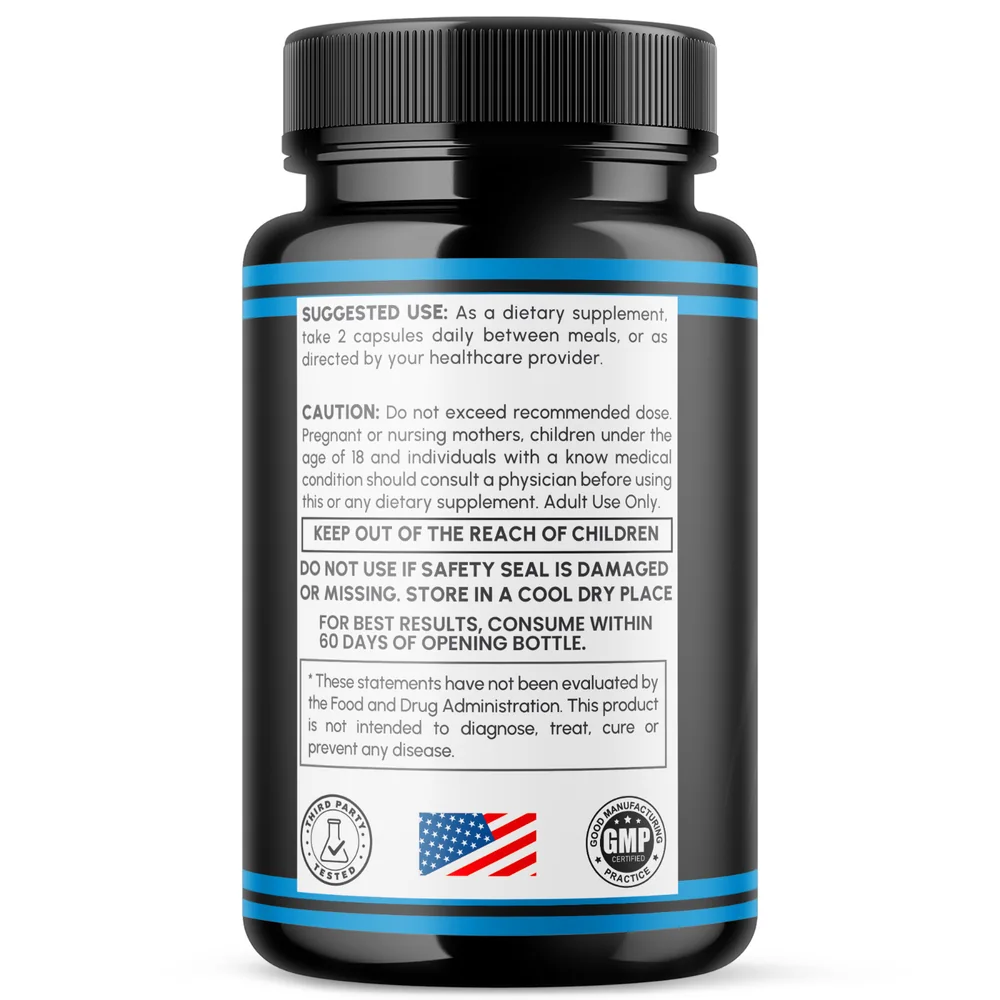
Sizing up the best male enhancement pills in stores starts on the back of the box
Everything printed on the front of a supplement carton exists to sell it. Words like "maximum", "advanced", "ultra" and "clinical strength" have no fixed definitions and no threshold you have to meet before using them. A picture of a root, a percentage in a starburst and a bold claim about vitality tell you about the marketing budget, not about the capsule. Meanwhile the back of the box carries a Supplement Facts panel, and that panel has formatting rules, required disclosures and a legally defined structure. It is the only surface on the package that has to behave.
This is the single most useful habit you can build in a supplement aisle: pick the product up, rotate it 180 degrees, and do not look at the front again until you have finished. People searching for the best male enhancement pills in stores are usually comparing front panels against each other, which is a comparison of copywriting. Compare the back panels instead and the differences become concrete and countable.
Note the vocabulary while you are there. "Male enhancement" is a shopper's phrase, not a regulated one. What is inside is a dietary supplement, and a dietary supplement is not permitted to be sold as a treatment for erectile difficulties, infertility or low testosterone. If the packaging in your hand is implying otherwise, that is itself a reason to put it back.
Check one: are there individual amounts at all?
Run your eye down the panel. Each active ingredient should have a name and a number beside it, expressed in milligrams or micrograms per serving. That sounds obvious, and yet a large share of vitality formulas manage to avoid it by grouping everything into a single line such as "Male Vitality Complex 1,250 mg" with the ingredients listed underneath, in no particular quantity.
Where individual amounts are present, you can do arithmetic. You can compare a product's tongkat ali content against the amounts used in published trials. You can see whether the zinc figure is a sensible daily contribution or a token sprinkle. Where amounts are absent, you cannot do any of that — and neither can anyone else, including the person recommending it to you.
Check two: proprietary blends and where the milligrams actually go
A proprietary blend is legal, common and occasionally defensible: a manufacturer can argue that publishing exact ratios hands its formula to competitors. In practice, blends are used far more often to make a small quantity of an expensive ingredient look like a lot. Ingredients within a blend must be listed in descending order by weight, which gives you one useful lever. If the blend totals 500 mg and the first item is a cheap filler-grade herb, everything after it is smaller still, and the botanical printed in large type on the front might be present in single-digit milligrams.
The practical rule: a blend is acceptable when the total is generous and the list is short. A 300 mg blend containing eleven named botanicals cannot be delivering a meaningful amount of any of them, whatever the front of the box says. That arithmetic is unforgiving, and it is the fastest way to separate serious formulas from decorative ones.
A panel you can read before you buy
Not every formula makes you find a shelf to check its label. Viril Edge publishes its full Supplement Facts panel, with named botanicals and individual amounts, on the official store page — so you can run all seven of these checks before you spend anything.
View the Official Label and StoreAd · you will be taken to the manufacturer's checkout
Check three: standardisation, not just a plant name
This is the check almost nobody runs, and it is the one that separates a research-grade ingredient from ground-up plant matter. Botanical extracts vary enormously in strength depending on the part of the plant used, the solvent, and how concentrated the finished extract is. Standardisation is the manufacturer's statement of that strength: an extract ratio such as 10:1, or a marker percentage such as "standardised to 20% icariins" for horny goat weed or "40% saponins" for a tribulus extract.
Why it matters: published trials use standardised material. When a study reports a benefit at 200 mg of a particular tongkat ali extract, that number is meaningless unless the extract in your hand was made to a comparable specification. A label reading simply "Eurycoma longifolia root 200 mg" tells you what went into the pot. A label reading "Eurycoma longifolia root extract (100:1) 200 mg" tells you how strong what came out of it is. We cover which of these botanicals actually have trial data behind them in our piece on tongkat ali, zinc and what the research shows.
Check four: serving size versus what you are paying for
Look for the line that reads "Serving size: 2 capsules" or similar, then find the capsule count on the bottle. A 60-capsule bottle with a two-capsule serving is a 30-day supply, not a two-month one. This is the single most common way shoppers misjudge cost, and it is deliberate often enough to be worth checking every time.
It also changes how you read the amounts. Every figure in the panel is per serving, not per capsule. A formula showing 400 mg of a botanical at a four-capsule serving is delivering 100 mg per capsule, which is a very different product from one delivering 400 mg in a single capsule. Convert everything to a per-day basis before you compare two boxes, or you will compare them wrongly.
Check five: the "other ingredients" line
Beneath the panel sits a short line most people skip entirely. It lists everything that is not an active: the capsule shell, flow agents, anti-caking compounds, colours and any allergen carriers. It is worth ten seconds for three reasons. If you avoid animal products, gelatin capsules are disclosed here and nowhere else. If you have an allergy, soy and dairy derivatives appear here. And if the list is unusually long relative to the actives, you are paying for a lot of manufacturing convenience.
None of these excipients are sinister on their own — magnesium stearate and silicon dioxide are standard processing aids across the whole industry. The point is that this line is the only place some of that information appears.
Check six: warnings and interactions
Every supplement carries a warning block, and in this category it is genuinely worth reading rather than skimming. Several botanicals common in male vitality formulas can interact with prescription medication. Horny goat weed and tribulus have both been associated with interactions involving blood-pressure medicines, nitrates and anticoagulants. Saw palmetto can matter if you are on a blood thinner or approaching prostate surgery. Yohimbe, which still appears in some shop-shelf products, has a considerably more serious safety profile than the rest and is a reason to put a box down if you take anything for your heart or blood pressure. We set out what that profile actually consists of, and which medications turn a warning into a hard no, in our guide to testosterone booster side effects and who should avoid them.
The warning block is the one part of the packaging written by someone who is not trying to sell you anything. That is exactly why it is worth the fifteen seconds.
The label should also state clearly that the product is not intended to diagnose, treat, cure or prevent any disease. If a shelf product is making disease claims anywhere on the carton, the mismatch between that claim and the required disclaimer tells you something about the company.
Check seven: manufacturer, lot number and date
Finally, look for a named company with a real address, a lot or batch number, and a best-before date. All three should be present. A lot number is what makes a product traceable if there is ever a recall, and a bottle without one is a bottle nobody can follow up. Check the date properly too: botanical potency is not indefinite, and a slow-moving shelf item bought close to expiry is not the same purchase as a fresh one, even at the same price.
The seven checks, side by side
| Check | What good looks like | Reason to hesitate |
|---|---|---|
| 1. Individual amounts | Every active has its own mg or mcg figure | One combined blend total only |
| 2. Blend size | Short list, generous total | Small total split across ten-plus botanicals |
| 3. Standardisation | Extract ratio or marker percentage stated | Plant name with no strength given |
| 4. Serving size | Capsule count and days of supply agree | Multi-capsule serving hidden in small print |
| 5. Other ingredients | Short, disclosed, allergens named | Long excipient list, vague "natural flavour" |
| 6. Warnings | Interactions and who should avoid it stated | No warning block, or disease claims on pack |
| 7. Traceability | Named maker, lot number, clear expiry | No lot code, distant or missing address |
What a two-minute label check cannot tell you
Being honest about the ceiling here matters. A label check verifies what a company says is in the bottle. It cannot verify that the contents match, and independent analyses over the years have repeatedly found products in this category whose contents did not match their panels. Only third-party testing addresses that, and a certificate of analysis is something you request or find published — not something you read off a carton in an aisle.
The check also cannot tell you whether the formula will do anything for you specifically. Ingredient evidence is not product evidence: a finished multi-botanical blend is almost never the thing that was trialled, even when each of its components has published research. If you want to see these seven checks run end to end on two competing products rather than described in the abstract, our side-by-side of Viril Edge and Nugenix Total-T works through exactly that. And it cannot substitute for a medical opinion. Persistent erectile difficulty, a marked drop in libido or ongoing fatigue can have cardiovascular, metabolic, hormonal or medication-related causes, and none of those are solved by a better label.
Finally, a good label does not tell you whether you are buying in a sensible channel. Shoppers hunting for the best male enhancement pills at gnc or the best male enhancement pills at cvs are already limited to whatever that chain's category manager chose to stock, which is a much narrower field than the category as a whole. Our channel-by-channel comparison of where to buy men's supplements covers what each retail route can and cannot protect you from.
Frequently asked questions
How do I judge the best male enhancement pills in stores quickly?
Turn the box over and read the Supplement Facts panel, not the front. Look for named ingredients with individual milligram amounts rather than a single proprietary blend total, check that the botanicals carry a standardisation figure, and confirm the serving size matches the bottle count you are paying for. Those three things take under two minutes and rule out most weak formulas.
What is a proprietary blend and why does it matter?
A proprietary blend is a group of ingredients listed together under one combined weight, so the label shows the total but not how much of each one is inside. It is legal and common, but it means you cannot tell whether the headline botanical is present at a meaningful amount or as a trace. Panels that break out individual amounts give you information a blend total hides.
Does a longer ingredient list mean a better formula?
No, and it often means the opposite. A capsule holds a limited amount of powder, so splitting that space across fifteen botanicals leaves very little of each. Formulas with fewer ingredients at amounts close to those used in published research are generally a better bet than a long list built to look impressive on the front of a box.
Should I buy a supplement without a standardisation figure on the label?
It is a reason for caution rather than an automatic no. Standardisation tells you the extract was made to a consistent strength, which is what makes one batch comparable to the next and to the material used in studies. A plant name with no extract ratio or percentage tells you what was in the pot, not how strong it is.
Medical note: this article explains how to read a label, not what to take. Speak to a healthcare professional before starting any supplement, particularly if you take blood-pressure medication, nitrates or anticoagulants, since several botanicals in this category can interact with them.
Scientific references
- NIH Office of Dietary Supplements — Fact sheets on individual nutrients and botanicals
- NIH NCCIH — Finding and Evaluating Online Resources
- NIH ODS — Zinc: Fact Sheet for Health Professionals
- Mayo Clinic — Drugs and Supplements: herb and drug interaction summaries
- PubMed — Balasubramanian et al. (2019), “Testosterone Imposters”: an analysis of the labels of popular online testosterone-boosting supplements
Run the checklist on Viril Edge
Viril Edge is not a shelf product, so the panel is published online instead. Our full ingredient breakdown of Viril Edge walks the same seven checks in order, and the official store lists the current pack options and price if you want to see them straight from the source.
See Packs and Price at the Official StoreAd · sold online only, so no aisle to check first